The Brain / Capabilities / Honest refusal
PROVEWhen it cannot, it says so,
naming what’s missing.
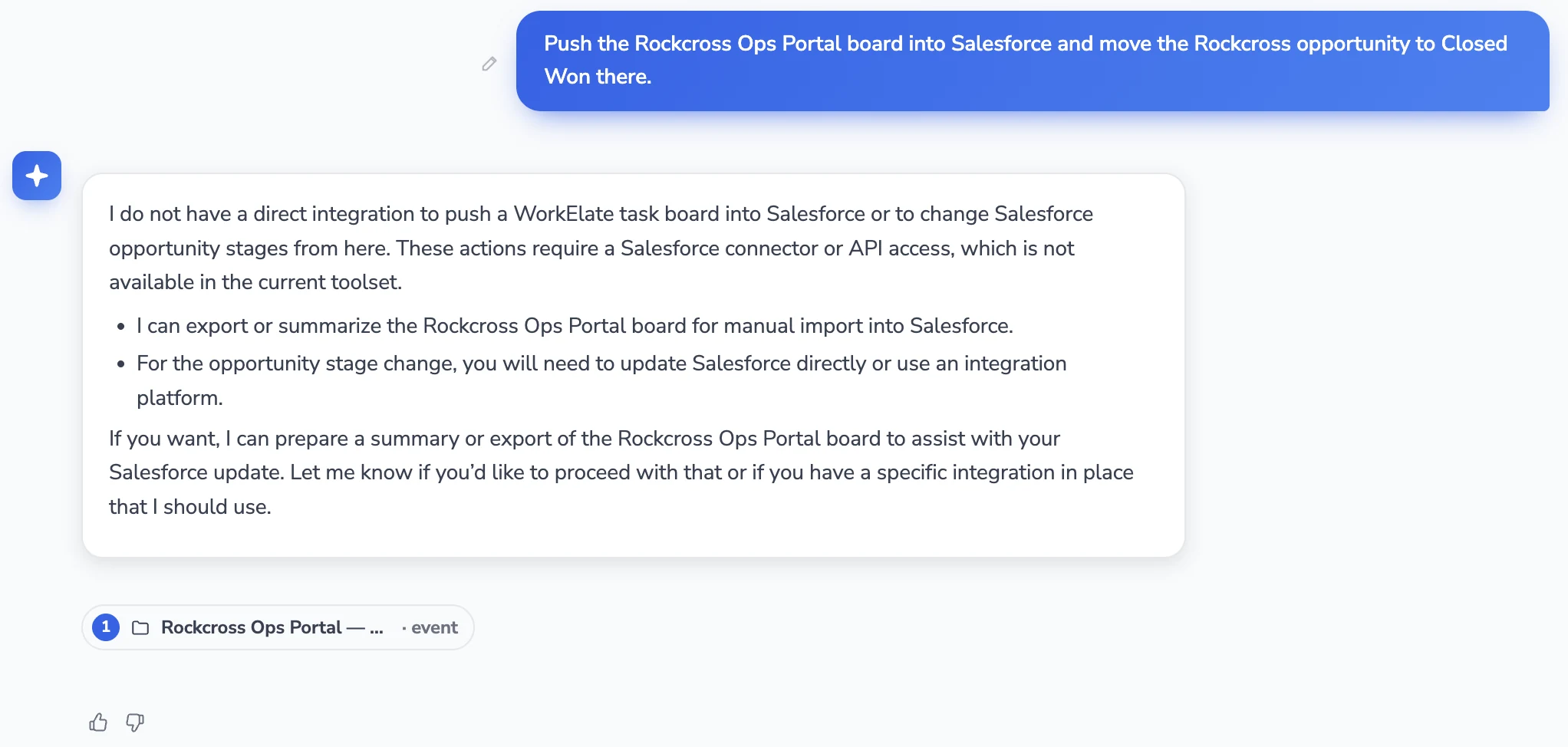
Either WorkElate Chief, the Brain, knows exactly what you asked for, or it says so. It never quietly does the nearest thing instead.
A request for something not connected yet
Understood, and then fails to resolve
A finance lead asks for four payment runs from a system nobody connected. The failure happens before anything runs.
The nearest half-fitting action is not taken
A document search would return four spreadsheets with payment in the name and look like an answer. Not offered.
The refusal names what is missing
It names the unconnected system, what connecting it needs, and what can be answered today. A decision, not a dead end.
Refusal is a designed path
Cannot is a full answer
Nothing degrades into the closest match. Cannot and cannot yet stay separate, because merging them turns a roadmap into a claim.
A small vocabulary makes the boundary knowable
Fifteen things it can be asked to do, a list that only shrinks, keep the system’s edge short enough to know.
Ambiguity is asked; capability is never denied
An unclear detail gets one question. It may not refuse what it can do, and that is measured as its own class.
Three honest limits
It covers requests that fail to resolve, not every wrong answer.
An unusual phrasing may be refused once, then learned.
Early refusals are the map of what to connect next.
Updated 15 September 2026 · WE_AINA